
Anomalous Transport in Dissolving Porous Media: Transitions Between Fickian and Non-Fickian Regimes
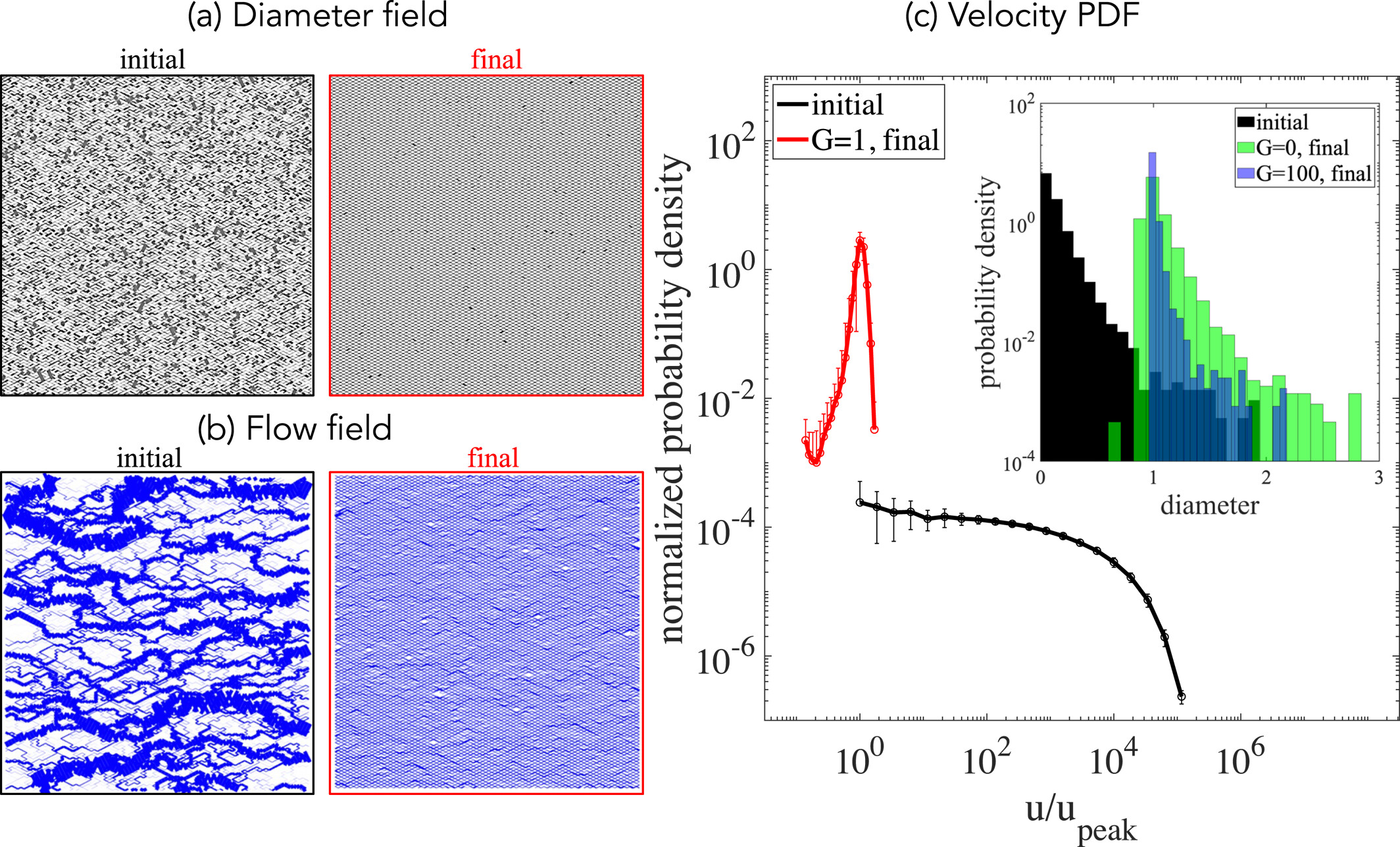
Mineral dissolution reshapes the internal structure of porous materials, creating distinct patterns such as wormholes. This process drives key geological phenomena, including the formation of caves, sinkholes, and subsurface drainage systems characteristic of karst terrains. The resulting structural changes significantly impact fluid flow and solute transport through porous materials. In this study, we investigated how the initial pore structure and two specific dissolution regimes—wormholing and uniform dissolution—affect solute movement. Our findings reveal that wormholing, through the development of preferential flow paths, gives rise to complex transport patterns (non-Fickian behavior). In contrast, uniform dissolution reduces structural heterogeneity, leading to more predictable solute movement (Fickian behavior), even in initially highly heterogeneous systems. We show that the transition between these transport behaviors is controlled by the interplay between initial pore structure and the prevailing dissolution regime. These findings improve our understanding of solute transport in subsurface systems, with important implications for managing groundwater resources, storing carbon dioxide underground, and mitigating environmental contamination.
Read our paper Deng et al. (2025).